By Mithun
Which mode to use, starter settings for Canon, Nikon and Sony, your first lens, and how to protect a camera from Indian heat and humidity.
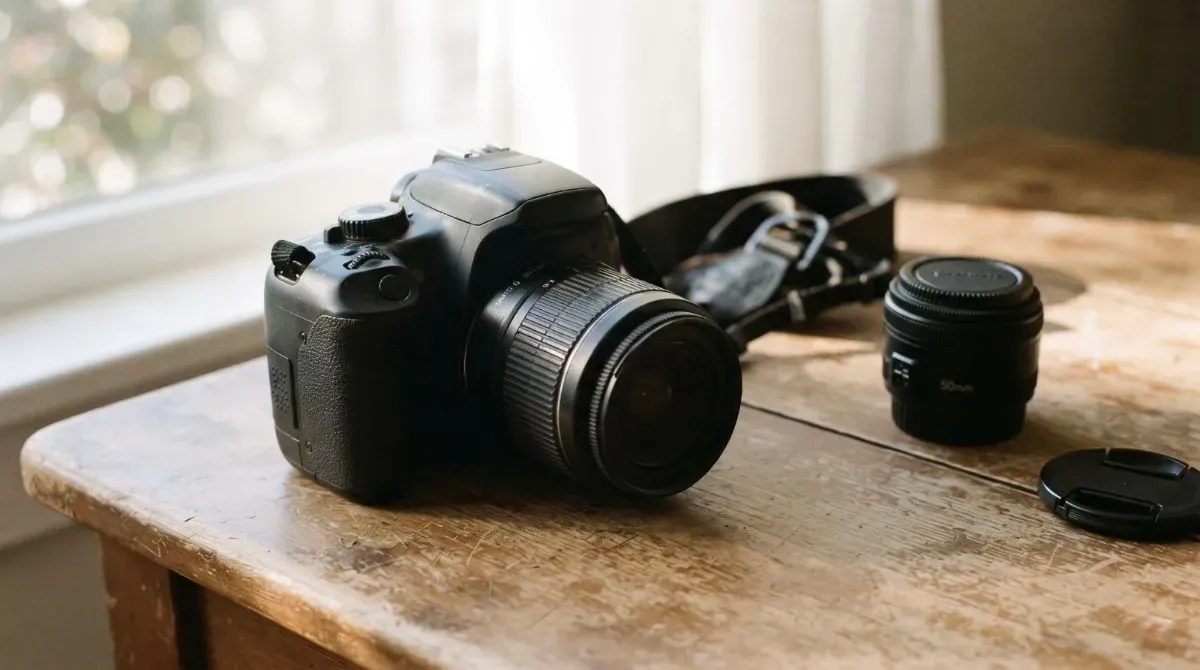
If you're new to DSLRs, learn three things first: Aperture Priority mode, a short list of starting settings, and the kit lens that comes with the camera. This guide covers each of them, along with how a DSLR compares with a mirrorless camera, which lens to buy next, and how to protect a camera from Indian heat and humidity. Mirrorless cameras use almost the same controls, so the advice works for both. More guides are in our Photography & Gear section.
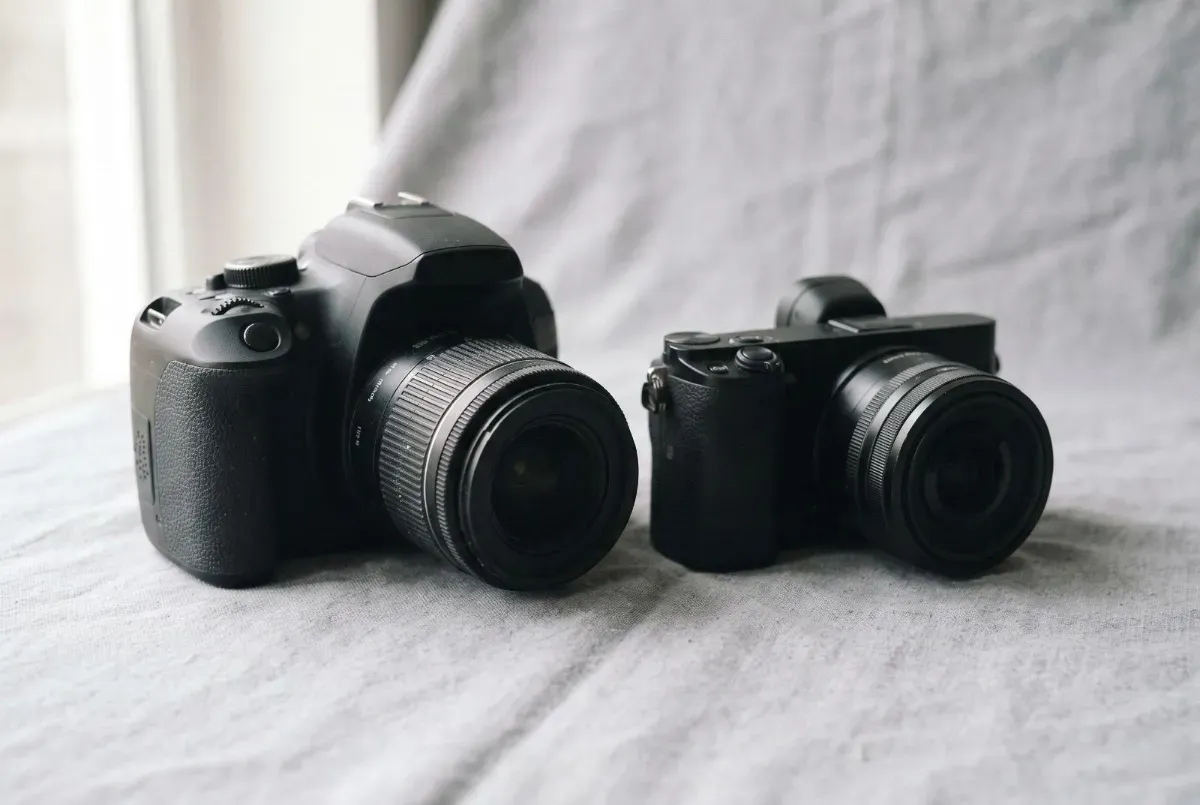
A DSLR (digital single-lens reflex) camera has a mirror behind the lens that sends light up to an optical viewfinder, so you see the scene through the lens itself. When you press the shutter button, the mirror flips up and light reaches the sensor, which records the photo. A mirrorless camera has no mirror, and its viewfinder is a small screen showing what the sensor sees, as Canon's guide to mirrorless and DSLR cameras explains.
Both take sharp photos and use the same controls, so a beginner can learn on either. They differ in size, battery life, video, and which system will get new cameras and lenses.
| DSLR | Mirrorless | |
|---|---|---|
| Viewfinder | Optical, shows the scene through the lens | Electronic, shows how bright the photo will be before you take it |
| Size and weight | Larger and heavier | Smaller and lighter |
| Battery life | About 1,200 shots per charge (Canon EOS 90D) | About 390 shots per charge (Canon EOS R6 Mark III) |
| Video | Basic | Better suited |
| New cameras and lenses | No new models being designed | Where every brand releases new models |
DSLR shipments fell 31% in 2025, to 7.3% of all cameras shipped, according to CIPA figures reported by DPReview. Nikon stopped making its beginner D3500 and D5600 in 2022, while Canon built an estimated 580,000 DSLRs in 2025, reports Digital Camera World.
You will likely keep your lenses longer than the camera body, so choose the lens system you want to grow into. Our guide to DSLR vs mirrorless cameras compares the two in detail.
Check four things before you buy: whether the camera has an eye-level viewfinder, how the grip feels in your hand, how many shots the battery lasts, and which lenses fit its mount.
Some new beginner cameras are built mainly for video and have no eye-level viewfinder, so you frame every photo on the rear screen. The Canon EOS R50 V, Sony ZV-E10 II and Fujifilm X-M5 are in this group.
Entry-level mirrorless cameras launched in India include the Canon EOS R50, which has an electronic viewfinder, and the Canon EOS R100, Nikon Z50 II, Sony ZV-E10 II and Fujifilm X-M5. If you choose a DSLR, check that the model is still sold new.
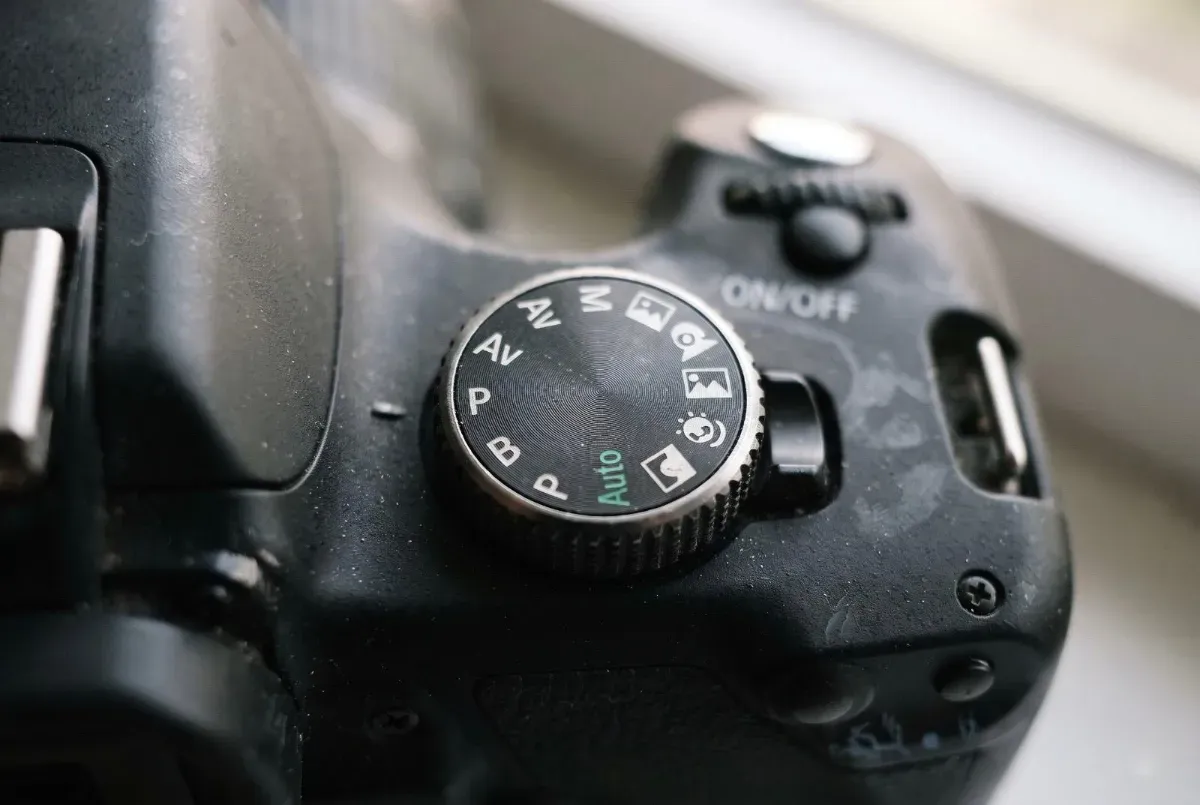
Start in Aperture Priority, marked Av on Canon and A on Nikon and Sony. You choose the aperture, which controls how blurred the background looks, and the camera sets the shutter speed. Canon calls these semi-automatic modes a good place to start.
| Mode | Canon | Nikon and Sony | You choose | The camera chooses |
|---|---|---|---|---|
| Program | P | P | ISO, white balance, flash | Aperture and shutter speed |
| Aperture Priority | Av | A | Aperture | Shutter speed |
| Shutter Priority | Tv | S | Shutter speed | Aperture |
| Manual | M | M | Aperture, shutter speed and ISO | Nothing, unless Auto ISO is on |
Use Shutter Priority when the subject moves quickly, such as at a match or a procession, so you can set a speed that freezes it.
These starting settings work on any brand. The table lists what Canon, Nikon and Sony each call the same setting.
| Setting | Start with | Canon | Nikon | Sony |
|---|---|---|---|---|
| Mode | Aperture Priority | Av | A | A |
| ISO | Auto, between 100 and 3200 | Auto | Auto ISO sensitivity control | ISO AUTO |
| Focus for still subjects | Single, locks once | One-Shot AF | AF-S | AF-S |
| Focus for moving subjects | Continuous, follows the subject | AI Servo (Servo AF on mirrorless) | AF-C | AF-C |
| Focus area | One point, moved onto the subject | 1-point AF | Single-point AF | Spot |
| Metering | Whole frame | Evaluative | Matrix | Multi |
| White balance | Auto | AWB | Auto | AWB |
| Stabilisation | On when handheld, off on a tripod | IS | VR | OSS (lens), SteadyShot (body) |
Treat 3200 as a starting limit, and take a few test shots at higher ISO to see how much grain you accept, as Digital Photography School's guide to Auto ISO suggests.
Shoot RAW + JPEG while you learn. A JPEG of about 5 to 20 MB is ready to share, while a RAW file of about 30 to 80 MB keeps more detail in bright and dark areas for editing, Digital Photography School explains. Our RAW vs JPEG guide covers when each is worth using.
Three settings control how bright a photo is, and each one also changes how it looks:
Each full step on any of the three doubles or halves the light, so you can trade one for another and keep the same brightness, as Cambridge in Colour's guide to exposure shows. Our exposure triangle guide explains each setting with examples.
To avoid blur from shaking hands, use a shutter speed of at least 1 divided by the focal length multiplied by the crop factor, which is 1.6 on Canon and 1.5 on Nikon and Sony beginner cameras. A 50mm lens on a Canon needs at least 1/80s, according to Digital Photography School's guide to the reciprocal rule.
Stand with your feet shoulder-width apart, tuck your elbows against your body and support the lens from below with your left hand. Press the viewfinder to your eye for a third point of support, and press the shutter as you breathe out. In low light, lean against a wall or pillar, as Adorama's guide to holding a camera steady recommends.
The 18-55mm or 16-50mm zoom sold with most beginner cameras covers about 24mm to 88mm in full-frame terms, wide enough for a room and long enough for a head-and-shoulders portrait. It is light and stabilised, and it is the right lens to learn on.
The usual next lens is a 50mm f/1.8. A kit zoom opens only to f/5.6 or f/6.3 at its long end, so the 50mm lets in about four to eight times more light, which allows faster shutter speeds indoors and a more blurred background. On a beginner camera it frames like a 75mm lens on Nikon and Sony and an 80mm lens on Canon, so it suits portraits. Mirrorless options include the Canon RF 50mm F1.8 STM, Sony FE 50mm F1.8 and Nikon Z 40mm f/2. Our 50mm lens guide compares them.
Heat. Nikon rates its batteries for use between 0°C and 40°C and for charging between 5°C and 35°C, according to its camera manual. Keep the camera bag in the shade and let a hot battery cool before charging it.
Humidity. Lens fungus grows from dust and moisture inside the lens, can permanently reduce sharpness, and is not covered by warranty, says Sony India. Sony India recommends storing the camera in a dry box with silica gel at 40 to 50% humidity, with the battery out and lens caps on. Keep it away from naphthalene balls, and fire the shutter a few times every month.
Condensation. Stepping from an air-conditioned room or car into hot air fogs the lens. Seal the camera in a plastic bag before you go out and open it after about an hour, as Sony's help guide advises.
Cleaning. Blow dust off the lens with a hand blower, then wipe smudges with a soft cloth. For the sensor, Canon India advises a blower only, never a brush or compressed air, and a service centre if a mark stays. Our guide to cleaning a camera lens covers each step.
Since July 2018, the Archaeological Survey of India has allowed photography inside all centrally protected monuments except the Ajanta Caves, the paintings at Leh Palace and the main mausoleum of the Taj Mahal, Travel Trends Today reported. For tripods and drones, ask at the ticket counter.
In Tamil Nadu, mobile phones have been banned inside major temples since 1 September 2026, following a Madras High Court order, Deccan Chronicle reports. Ask at the entrance before taking a camera in, and ask people before you photograph them.
A DSLR still takes sharp photos and gets more shots per battery charge, but camera makers are no longer designing new DSLRs. If you want a system that will keep getting new cameras and lenses, choose mirrorless.
Start with Aperture Priority (Av on Canon, A on Nikon and Sony) and Auto ISO. Move to Manual once you understand how aperture, shutter speed and ISO work together.
Learn on the kit zoom that comes with the camera, then add a 50mm f/1.8. It lets in about four to eight times more light than a kit lens and gives a more blurred background.
Yes, with the maker’s adapter. Canon’s EF-EOS R adapter keeps autofocus and stabilisation with EF and EF-S lenses, while Nikon’s FTZ adapter keeps autofocus only with lenses marked AF-S or AF-P.